

Home Modifications for Seniors: The Complete Safety Checklist
One in four adults age 65 and older falls every year in the United States, according to the Centers for Disease Control and Prevention. Falls are the leading cause of fatal and non-fatal injuries among older adults, resulting in approximately 3 million emergency department visits and 1 million hospitalizations each year. In 2020, health care spending for non-fatal falls among older adults reached $80 billion. And yet most of those falls are preventable.
The uncomfortable truth is that most homes are not designed with aging in mind. Only about 10 percent of U.S. homes have the features needed to support someone as they age, according to U.S. Census Bureau data. The good news is that targeted modifications can dramatically reduce fall risk and extend the years a senior can safely and comfortably remain at home.
Linda Clement, Certified Senior Advisor (CSA)® and Certified Placement and Referral Specialist (CPRS), is the founder of Peace of Mind Senior Solutions LLC, based in Dallas-Fort Worth, Texas. Through free consultations with Dallas-Fort Worth families, Linda regularly helps families assess whether a home can be made safe enough for aging in place or whether a transition to assisted living makes more sense. This room-by-room checklist reflects the safety priorities that matter most.
Start Here: Get a Professional Home Safety Assessment
Before spending money on modifications, the single most valuable step a family can take is arranging a professional home safety assessment. Two types of professionals specialize in this work.
An Occupational Therapist, or OT, can conduct a comprehensive evaluation of the home in relation to the senior’s specific physical and cognitive abilities. They identify hazards based on the individual’s unique risk factors, not just general checklists. Many health insurance plans and Medicare Advantage plans cover OT home assessments when a physician writes a referral, making this a potentially free first step.
A Certified Aging-in-Place Specialist (CAPS) is a contractor who has completed specialized training through the National Association of Home Builders on aging-in-place modifications. They can assess the home from a construction standpoint and provide a phased modification plan that fits the budget and anticipates future needs. You can search for a CAPS-certified professional through the National Association of Home Builders website.
A professional assessment is the roadmap. Without it, families often spend money on modifications that are not the highest priority, while missing hazards that matter most.
The Bathroom: The Highest Priority Room
If there is one room to address first, it is the bathroom. Falls most frequently occur in the bathroom due to wet surfaces, hard fixtures, and the physical demands of bathing. A 2025 systematic review published in the journal Healthcare confirmed that grab bars and non-slip surfaces were present in every effective home modification intervention studied.
Grab Bars
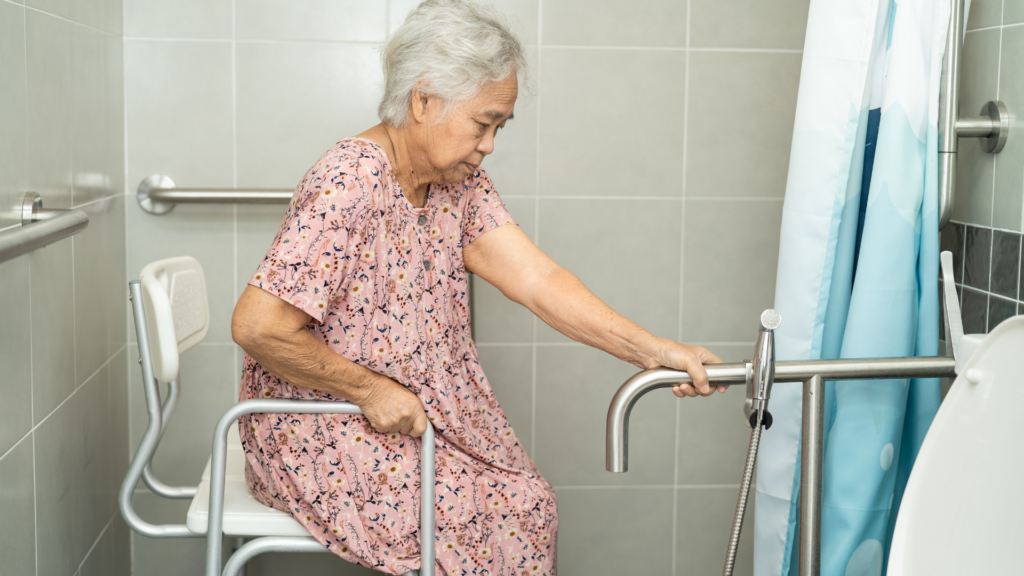
Grab bars at the toilet and inside the shower or tub are the single most important bathroom modification. Standard grab bars cost $20 to $150, depending on the style and finish. Professional installation, which is strongly recommended because bars must be anchored into wall studs to safely bear weight, runs $150 to $400 per bar. Suction-cup bars are available for under $30 and can be installed immediately, but they are not a permanent solution and should not replace properly anchored bars for a senior with significant balance concerns.
Non-Slip Surfaces
Non-slip decals or textured mats applied to the tub or shower floor cost under $30 and take minutes to install. Bathroom floor rugs should have a non-slip backing or be removed entirely. These small changes address one of the most common causes of bathroom falls.
Handheld Showerhead
A handheld showerhead on a sliding bar costs $40 to $120 and allows bathing while seated, dramatically improving safety and comfort for seniors with limited mobility or balance challenges. This is one of the most cost-effective modifications available.
Shower Seat or Bench
A fold-down teak bench or a basic shower chair costs $50 to $200 and eliminates the need to stand while showering. For seniors who are unsteady on their feet, this modification alone can prevent a serious fall.
Walk-In Shower or Tub
Converting a standard tub to a walk-in shower eliminates the step-over that causes many bathroom falls. A basic conversion runs $3,000 to $8,000. A full bathroom renovation that includes widening the doorway for wheelchair access and installing a roll-in shower can cost $15,000 or more. This is a larger investment, but it can be essential for seniors with significant mobility limitations.
Raised Toilet Seat
A raised toilet seat or a toilet safety frame costs $30 to $150 and makes it significantly easier to sit down and stand up, reducing the strain and fall risk associated with low toilet height. These are available without a prescription and install in minutes.
Entryways and Exterior: Safe Access In and Out
A senior who cannot safely enter and exit their home has effectively lost their independence, regardless of how well-modified the interior is. Exterior access is often overlooked until it becomes urgent.
Step-Free Entry
Installing a modular aluminum ramp to bypass front porch stairs typically costs $1,000 to $3,000, depending on the required rise and length. This is frequently the modification that makes the difference between a senior being able to return home after a hospitalization or needing to transition directly to a care facility. Ramps should have handrails on both sides and a non-slip surface.
Handrails
Any exterior steps should have sturdy handrails on at least one side, ideally both. Handrail installation costs $150 to $600, depending on material and length. Rails should extend the full length of the steps and be grippable rather than decorative.
Lighting
Motion-activated porch lights eliminate the need to navigate dark exterior spaces and reduce fall risk after dark. These cost $30 to $150 per fixture and can be installed by a handyman or capable family member. Good lighting at the entry is one of the least expensive and most impactful modifications available.
Door Hardware
Standard round doorknobs can be difficult or impossible for seniors with arthritis or reduced hand strength to operate. Replacing knobs with lever-style handles costs $20 to $80 per door and makes entry and movement throughout the home significantly easier.
Living Areas and Hallways: Clear Paths and Good Lighting
Falls do not only happen in bathrooms. Living areas and hallways present real hazards, particularly at night or for seniors with vision changes.
Clear Pathways
Remove throw rugs, extension cords, and any clutter from pathways throughout the home. This costs nothing but attention and effort and eliminates one of the most common trip hazards in the home. Loose area rugs are particularly dangerous and should either be secured with non-slip backing and tape or removed entirely.
Lighting Throughout the Home
Nightlights in hallways, bathrooms, and stairwells provide continuous illumination for the path between the bedroom and bathroom, which is one of the highest-risk routes for nighttime falls. Motion-activated nightlights cost $10 to $30 each. Installing additional overhead lighting in dim areas typically runs $100 to $300 per fixture installed by an electrician.
Furniture Arrangement
Arrange furniture so it does not block pathways and can be used for support while walking. Heavy, stable pieces like sofas and chairs can serve as natural grab points if placed thoughtfully. Remove lightweight or unstable pieces that a senior might grab for support, but that could tip.
Stair Safety
Any home with stairs presents risk. Handrails should be present on both sides of all staircases and should be firmly anchored. Non-slip treads applied to stair surfaces cost $30 to $100 per staircase. Stair lifts, which allow a senior to ride between floors without climbing, cost $3,000 to $10,000 installed depending on the staircase configuration. For seniors with significant mobility limitations, relocating the primary living and sleeping areas to a single floor eliminates stair risk at a lower cost than a lift.
Bedroom: Safety Where Sleep and Morning Risk Collide
The bedroom presents specific risks, particularly during transitions from lying down to standing and during nighttime trips to the bathroom.
Bed Height
A bed that is too low makes it very difficult to stand up safely and significantly increases fall risk. The ideal bed height allows a person to sit on the edge with feet flat on the floor and knees at approximately 90 degrees. Bed risers can raise a low bed by about $20 to $50. Adjustable beds that allow head and foot positioning can also improve safety and comfort and typically cost $1,000 to $4,000.
Nighttime Lighting
Motion-activated lighting along the bedroom-to-bathroom path is one of the simplest and most effective ways to reduce nighttime falls. Under-bed nightlights that activate when a person swings their legs over the edge cost $20 to $50 and ensure the floor is illuminated before feet touch it. Combined with nightlights in the hallway and bathroom, this creates a continuously lit path for the most common nighttime route.
Phone and Emergency Access
A phone should always be within reach of the bed. A medical alert device worn on the wrist or as a pendant ensures a senior can call for help if they fall and cannot reach a phone. These devices typically cost $20 to $50 per month for monitoring service and are discussed in more detail in our separate guide to medical alert systems.
Kitchen: Managing Risk in a High-Activity Space
The kitchen is where many seniors spend significant time, and where the combination of hot surfaces, wet floors, and reaching and bending creates meaningful risk.
Slip-Resistant Flooring
If the kitchen has smooth tile or hardwood flooring, non-slip mats near the sink and stove provide traction in the areas where spills are most likely. Anti-fatigue mats that are also non-slip serve double duty. These cost $20 to $80 each.
Reorganize Storage
Move frequently used items to between knee and shoulder height to eliminate the need to reach high or bend low. This costs nothing but reorganization time and eliminates a significant cause of kitchen falls and injuries.
Stove Safety
Stove knob covers that require deliberate manipulation to turn on can prevent accidental ignition for seniors with cognitive changes. Automatic stove shut-off devices, which cut power if the stove is left on without activity, cost $100 to $200 and provide significant safety for seniors who are sometimes forgetful.
Lever Faucets
Single-lever faucets are far easier to operate than two-handled faucets for seniors with arthritis or reduced hand strength. Replacing a kitchen faucet typically costs $150 to $400 installed.
Financial Assistance for Home Modifications
The cost of home modifications ranges from under $30 for basic grab bars to $15,000 or more for full bathroom renovations. Several funding sources can offset these costs for qualifying seniors.
Medicare Advantage supplemental benefits: As of 2025, approximately 33 percent of Medicare Advantage plans offer home modification benefits, including grab bars, non-slip flooring, and ramps. Contact your plan directly to ask what is covered and what documentation is required.
VA grants for veterans: Eligible veterans may apply for the Home Improvements and Structural Alterations grant (HISA), which provides up to $6,800 for service-connected veterans and up to $2,000 for non-service-connected veterans. The Specially Adapted Housing grant, known as SAH, provides significantly larger amounts for veterans with severe service-connected disabilities. Contact the VA or the Texas Veterans Commission for assistance with the application.
Medicaid Home and Community-Based Services waivers: The Texas STAR+PLUS waiver can, in some cases, cover home modifications and accessibility adaptations for eligible low-income seniors. Eligibility requires meeting both clinical and financial thresholds.
HUD Older Adults Home Modification Program: This federal program provides grants of up to approximately $5,000 for low-income seniors for essential safety modifications.
Area Agency on Aging: Local Area Agencies on Aging sometimes administer grant programs and low-cost modification services for qualifying seniors. In the Dallas-Fort Worth area, the Area Agency on Aging of Tarrant County is a good starting point. You can find your local agency at eldercare.acl.gov.
USDA Section 504 Home Repair Program: Provides grants up to $10,000 and loans to low-income rural homeowners for safety modifications.
When Home Modifications Are No Longer Enough
Home modifications can significantly extend independent living, but they are not a solution for every situation. For some seniors, there comes a point when the home, even with modifications, cannot provide the level of safety and support needed.
Signs that home modifications may not be sufficient include a senior who has fallen multiple times despite modifications being in place, a senior with progressing dementia whose supervision needs exceed what a modified home and family support can provide, or a senior who has become deeply isolated in ways that modifications cannot address.
When that point arrives, the conversation shifts from how to make the current situation safer to what living arrangement will actually support the best quality of life going forward. That is a conversation worth having before a crisis forces it.
A Certified Senior Advisor can help families assess whether a home can be made safe enough for aging in place or whether assisted living is the more realistic path for a specific situation. That assessment is free and carries no obligation.
Ready to Talk Through Your Options?
If you are navigating senior living options right now, you do not have to figure it out alone. I offer a free, no-pressure consultation for families in the Dallas-Fort Worth area who are trying to determine the right next step for their loved one. My job is to understand your specific situation, answer your questions honestly, and help you find the right fit. If you are not in DFW, I can still point you in the right direction. You can reach me in three ways:
– Call or text: 817-357-4334
– Email: info@peaceofmindseniorsolutions.com
– Complete our contact form
There is no obligation and no cost. Just an honest conversation with a Certified Senior Advisor who has helped many DFW families through exactly what you are facing right now.
Frequently Asked Questions
What are the most important home modifications for seniors?
The bathroom is the highest priority. Grab bars at the toilet and in the shower or tub, non-slip surfaces, and a handheld showerhead address the most common and serious fall hazards. After the bathroom, focus on step-free exterior access, good lighting throughout the home, and clear pathways free of rugs and clutter.
How much do home modifications for seniors cost?
Costs range widely depending on the scope of work. Basic modifications, such as grab bars, non-slip mats, and nightlights, can be done for a few hundred dollars. Mid-range projects, such as installing a walk-in shower or stair lift, typically run $3,000 to $10,000. Full bathroom or entry renovations for wheelchair access can cost $15,000 or more. Most families take a phased approach, starting with the highest-priority modifications first.
Does Medicare cover home modifications for seniors?
Original Medicare does not cover most home modifications. However, approximately 33 percent of Medicare Advantage plans offered home modification benefits as of 2025, covering items such as grab bars, non-slip flooring, and ramps. An occupational therapy home assessment may be covered when ordered by a physician. Veterans may qualify for VA modification grants regardless of Medicare plan type.
Who should assess the home before making modifications?
An occupational therapist can evaluate the home in relation to the senior’s specific physical and cognitive abilities and recommend modifications tailored to their individual risk factors. A Certified Aging-in-Place Specialist, or CAPS contractor, can assess the home from a construction standpoint and provide a phased plan. Starting with a professional assessment rather than guessing at priorities typically saves money and ensures the most important hazards are addressed first.
At what point are home modifications no longer enough?
When a senior has fallen multiple times despite modifications being in place, when progressing dementia creates supervision needs that exceed what a modified home can safely address, or when deep social isolation has set in, it may be time to consider whether assisted living would better serve the situation. A Certified Senior Advisor can help families think through this question honestly and without pressure.
What financial assistance is available for home modifications?
Several sources of assistance exist for qualifying seniors including Medicare Advantage supplemental benefits, VA grants for eligible veterans, the Texas STAR+PLUS Medicaid waiver, HUD grants for low-income seniors, and programs administered through the local Area Agency on Aging. The starting point for most families is to check Medicare Advantage plan benefits and contact the local Area Agency on Aging to learn what programs are available in their area.
About the Author
Linda Clement, Certified Senior Advisor (CSA)® and Certified Placement and Referral Specialist (CPRS), is the founder of Peace of Mind Senior Solutions LLC, based in Dallas-Fort Worth, Texas. With 20 years of experience in senior healthcare operations, Linda helps Dallas-Fort Worth and other families nationwide navigate senior housing and care decisions with honest, pressure-free guidance. For personalized assistance, contact Linda at info@peaceofmindseniorsolutions.com